Last updated: November 2026. Human compiled and fact checked against each named source on 19 November 2026.
Ireland’s construction workforce has grown by almost half since 2021 and reached its highest level since 2008 earlier this year, yet output is falling, housing activity is contracting and the industry still employs far fewer people than at the 2007 peak. Wages have overtaken the national average, apprenticeships are at record levels, and fatal accidents on sites doubled in 2025. This page gathers the current Irish figures on the people who build, what they earn, how they are trained, what the industry produces and how safe it is, each linked to its source. It is part of a series with our building and renovation cost statistics, planning permission statistics and building defects statistics.
Key Construction Industry Statistics for Ireland at a Glance
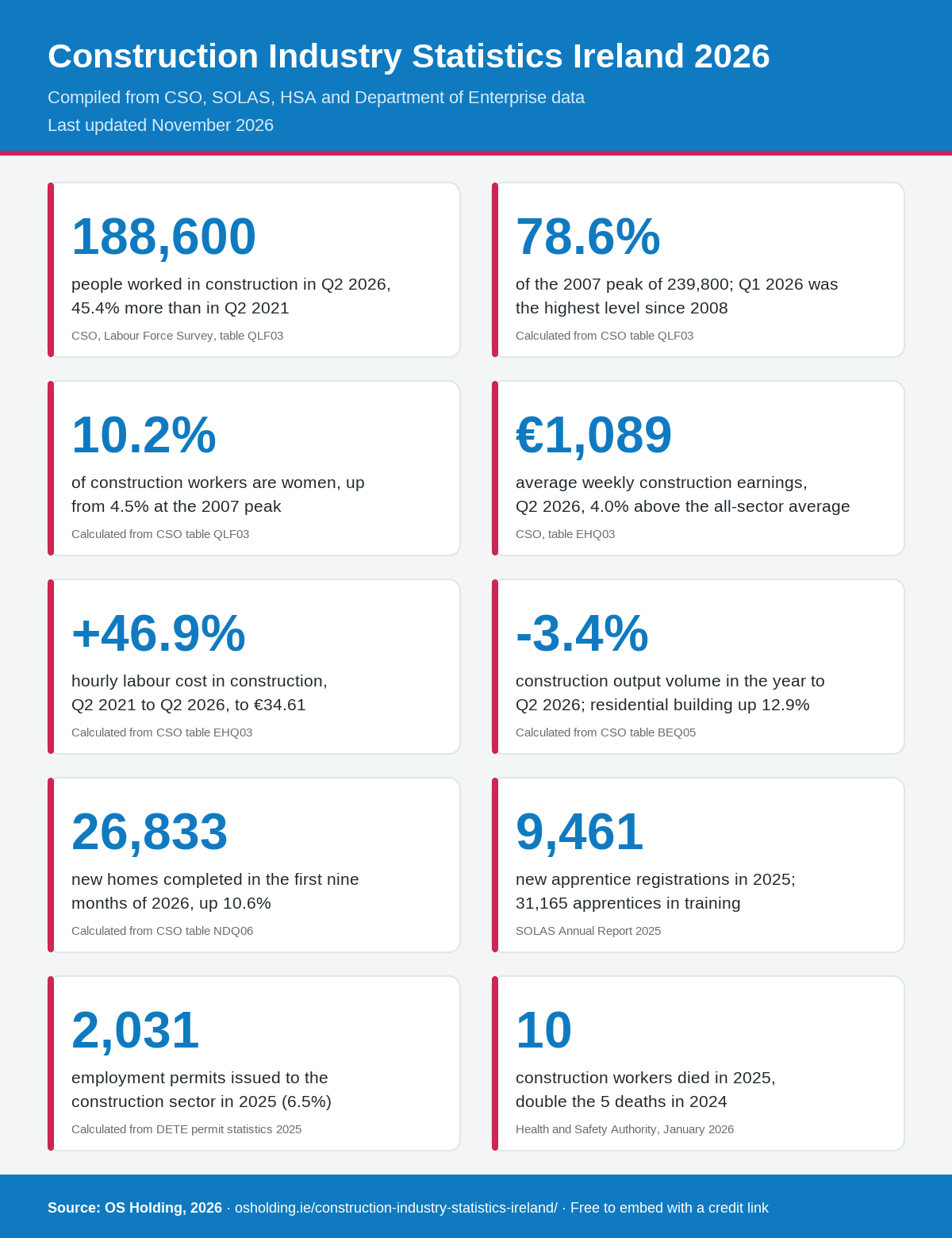
- 188,600 people worked in construction in the second quarter of 2026, 45.4% more than in the same quarter of 2021 (calculated). Source: CSO, Labour Force Survey, table QLF03
- Construction employment reached 195,600 in the first quarter of 2026, the highest since the third quarter of 2008 (calculated). Source: CSO, table QLF03
- That is still 78.6% of the 2007 peak of 239,800 (calculated). Source: CSO, table QLF03
- Women made up 10.2% of the construction workforce in mid-2026, up from 4.5% in 2007 (calculated). Source: CSO, table QLF03
- Average weekly earnings in construction were €1,089 in the second quarter of 2026, 4.0% above the all-sector average (calculated). Source: CSO, Earnings and Labour Costs, table EHQ03
- The volume of construction output fell 3.4% in the year to the second quarter of 2026, while residential building rose 12.9% (calculated). Source: CSO, Production in Building and Construction, table BEQ05
- The AIB construction PMI fell to 48.0 in October 2026, with housing activity at 45.6. Source: AIB PMI reported by the Irish Times, November 2026
- 9,461 new apprentices registered in 2025, and the apprentice population stood at 31,165. Source: SOLAS Annual Report 2025
- Only 59 of the 4,056 people who completed craft apprenticeships in 2025 were women, 1.5%. Source: Department of Further and Higher Education figures reported by the Irish Times
- 10 people died in construction work in 2025, double the 5 in 2024. Source: Health and Safety Authority, January 2026
How Many People Work in Construction
The CSO’s Labour Force Survey counts everyone whose main job is in the construction sector, including employees and the self-employed. In the second quarter of 2026, 188,600 people worked in construction, 6.6% of everyone in employment, according to CSO table QLF03. That is 45.4% more than the 129,700 in the second quarter of 2021, but slightly below the 190,300 a year earlier, a fall of 0.9% (calculated). The first quarter of 2026 recorded 195,600, the highest since the third quarter of 2008.
| Quarter | Construction employment | Share of all employment |
|---|---|---|
| Q2 2007 (peak) | 239,800 | 10.8% |
| Q1 2013 (low) | 80,200 | 4.2% |
| Q2 2019 | 146,800 | 6.4% |
| Q2 2021 | 129,700 | 5.4% |
| Q2 2024 | 160,700 | 5.8% |
| Q2 2025 | 190,300 | 6.8% |
| Q2 2026 | 188,600 | 6.6% |
Source: CSO, Labour Force Survey, table QLF03, persons aged 15 to 89 in employment, not seasonally adjusted, updated 20 August 2026. Shares calculated. The Q3 2026 survey is due in November 2026.
The industry is still well short of the boom. The 2026 workforce is 78.6% of the 239,800 employed in the second quarter of 2007, when construction accounted for more than one job in ten, and more than twice the low of 80,200 reached in the first quarter of 2013 (calculated).
Women in Construction
Construction remains overwhelmingly male, but the share of women is rising. In the second quarter of 2026, 19,200 women worked in the sector, 10.2% of the workforce, up from 10,500 or 8.1% in 2021 and 4.5% in 2007 (calculated from CSO table QLF03). In the trades the gap is starker: of the 4,056 people who completed craft apprenticeships in 2025, only 59 were women, including two of 561 new plumbers, 31 of 2,024 new electricians and none of the 442 carpenters and joiners, according to Department of Further and Higher Education figures reported by the Irish Times. The number of women entering craft apprenticeships rose from 129 in 2021 to 226 in 2025.
What Construction Workers Earn
Construction pay has moved above the national average. Average weekly earnings in the sector were €1,089.21 in the second quarter of 2026, up 4.3% on a year earlier and 30.6% on the second quarter of 2021, against €1,046.88 across all sectors, according to CSO table EHQ03 (changes calculated). The difference comes from longer hours rather than higher hourly rates: construction employees were paid for 36.5 hours a week against 32.8 across the economy, while average hourly earnings were €29.88 against €31.96. Over the year to the second quarter of 2026, construction pay rose 4.3% against 3.9% across all sectors (calculated), so the gap is still widening.
| Q2 2026 | Construction | All sectors |
|---|---|---|
| Average weekly earnings | €1,089.21 | €1,046.88 |
| Average hourly earnings | €29.88 | €31.96 |
| Average weekly paid hours | 36.5 | 32.8 |
| Average hourly total labour cost | €34.61 | €37.73 |
Source: CSO, Earnings, Hours and Employment Costs Survey, table EHQ03, updated 25 August 2026. Total labour cost includes employer social contributions and other costs on top of pay.
For anyone pricing building work, the labour cost figure matters most. The average hourly cost of employing someone in construction rose from €23.56 in the second quarter of 2021 to €34.61 in the second quarter of 2026, an increase of 46.9% in five years (calculated). Our building and renovation cost statistics show how that feeds into tender prices.
Construction Output
More workers have not meant more output this year. The CSO’s index of the volume of production in building and construction fell 3.4% between the second quarter of 2025 and the second quarter of 2026. Residential building was the exception, rising 12.9%, while non-residential building fell 18.0% and civil engineering fell 4.5% (calculated from CSO table BEQ05, base 2021 = 100, not seasonally adjusted).
Forward-looking surveys point to a weaker end to the year. The AIB construction purchasing managers’ index fell from 50.4 in September to 48.0 in October 2026, below the 50 mark that separates growth from contraction. Housing activity scored 45.6, commercial 49.2 and civil engineering 44.9, with firms blaming higher oil and fuel costs, and staffing levels fell for a second month, as reported by the Irish Times on 10 November 2026.
Homes Completed in 2026
The clearest output measure for housing is completions. The CSO recorded 26,833 new homes completed in the first nine months of 2026, 10.6% more than the 24,256 in the same period of 2025, including 10,154 in the third quarter alone, up 10.4% on the 9,197 completed in the third quarter of 2025 (calculated from CSO New Dwelling Completions table NDQ06, updated 29 October 2026). Houses in schemes made up 13,993 of the nine month total, apartments 8,475 and single one-off houses 4,365.
| New homes completed, January to September | 2025 | 2026 |
|---|---|---|
| Scheme houses | 12,224 | 13,993 |
| Apartments | 7,948 | 8,475 |
| Single houses | 4,084 | 4,365 |
| Total | 24,256 | 26,833 |
Source: CSO, New Dwelling Completions, table NDQ06, sums of quarterly figures.
Workers From Abroad
Employment permits fill some of the gap. The Department of Enterprise issued 2,031 employment permits to the construction sector in 2025, 6.5% of the 31,044 permits issued across all sectors, making construction the fifth largest sector after health and social work, information and communication, accommodation and food, and other services (calculated from the Department’s permits by sector statistics for 2025). In May 2026 the Government added construction planners and scheduling and geospatial surveyors to the critical skills list and made five more construction roles eligible for general employment permits, including steel fixers and curtain wallers, so that almost all occupations in the sector are now covered, according to the Department of Enterprise, Tourism and Employment.
Apprentices and Training
The apprenticeship system is larger than ever. There were 9,461 new apprentice registrations across 78 programmes in 2025, and 31,165 apprentices in training at the end of the year, including 3,021 women, 9.7% of the total (calculated), according to the SOLAS Annual Report 2025. These figures cover all apprenticeships, including newer programmes in sectors such as finance and ICT, not only construction trades.
The construction trades dominate qualifications. Of the 4,056 craft apprenticeship certificates awarded in 2025, 2,024 were in electrical, 49.9% of the total, with 561 in plumbing and 442 in carpentry and joinery (calculated from the Department figures reported by the Irish Times). SOLAS also issued 144,000 cards in 2025 under its Safe Pass, Construction Skills Certification Scheme and Quarry Skills Certification Scheme safety training programmes.
Safety on Construction Sites
Construction deaths doubled in 2025. The Health and Safety Authority recorded 10 construction fatalities in 2025, against 5 in 2024, within a provisional total of 58 work-related deaths across all sectors, according to its January 2026 release. The leading causes across all sectors were being hit or crushed by falling objects, incidents with machinery or vehicles, and falls from height. Across all sectors, self-employed people accounted for 23 of the 58 deaths, 40%, and 19 of those who died were aged 65 or over, and the Authority singled out agriculture and construction as high-risk sectors for people working alone. The Authority’s 2025 annual report later put the total at 61 workplace deaths.
Construction is also where the Authority spends most of its inspection effort. In 2025 it carried out 2,845 inspections and investigations in the sector, issued 286 prohibition notices and 55 improvement notices or directions, and gave written advice on 2,248 occasions, more than in any other sector. A joint campaign on working at height with the Northern Ireland safety authority found that work at height risk assessment was inadequate in 27% of the 549 inspections, according to the same annual report.
What the Figures Mean for Homeowners
For anyone planning building work, the numbers point to a tight market. Labour costs have risen 46.9% in five years, the workforce has stopped growing over the past year, and the industry’s own surveys show firms cutting staff as input costs rise. Booking early, getting a written and itemised quote, and checking that a builder takes site safety seriously all matter more in a stretched market. Our guide to finding a reliable builder covers the checks in more detail.
Method and Sources
Every figure was taken from the named source on 19 November 2026: CSO Labour Force Survey table QLF03, persons in employment by NACE sector and sex, updated 20 August 2026; CSO Earnings, Hours and Employment Costs Survey table EHQ03, updated 25 August 2026; CSO Production in Building and Construction table BEQ05, updated 26 August 2026; the AIB construction PMI for October 2026 as reported by the Irish Times on 10 November 2026; the SOLAS Annual Report and Accounts 2025; Department of Further and Higher Education apprenticeship completion figures as reported by the Irish Times on 11 August 2026; and the Health and Safety Authority release of 5 January 2026 and its Annual Report 2025; CSO New Dwelling Completions table NDQ06, updated 29 October 2026; and the Department of Enterprise, Tourism and Employment permits by sector statistics for 2025 and its release of 28 May 2026. Employment figures are not seasonally adjusted. Figures marked calculated were derived by OS Holding from these sources, specifically the employment changes, shares and comparisons with 2007 and 2013, the earnings and labour cost changes, the output and completion changes, the permit share, the share of women and the share of electrical certificates. The page will be refreshed with each quarterly CSO labour force, earnings and output release, the monthly PMI and the 2026 safety statistics.
How OS Holding Helps
OS Holding is a Dublin building contractor carrying out extensions, renovations and attic conversions with dedicated project management, and every job is priced in a written, itemised quote before work starts. For a quote, request a quote or contact the team. Journalists and researchers are welcome to quote any figure here with a link to the source and to this page.
