Last updated: November 2026. Human compiled and fact checked against each named source on 25 November 2026.
Public drinking water in Ireland passes almost every test, yet tens of thousands of homes are still fed through lead pipes, more than a third of treated water leaks away before it reaches a tap, and the water and waste systems of rural homes are largely unregulated. Lead was used in Irish plumbing up to and including the 1970s, and four in ten homes in the country were built before 1981. This page gathers the current Irish figures on lead pipes, the grants to replace them, water quality, leakage, boil water notices, private wells and septic tanks, each linked to its source. It is part of a series with our period and older homes statistics, damp, mould and radon statistics and housing stock statistics.
Key Lead Pipe and Drinking Water Statistics for Ireland at a Glance
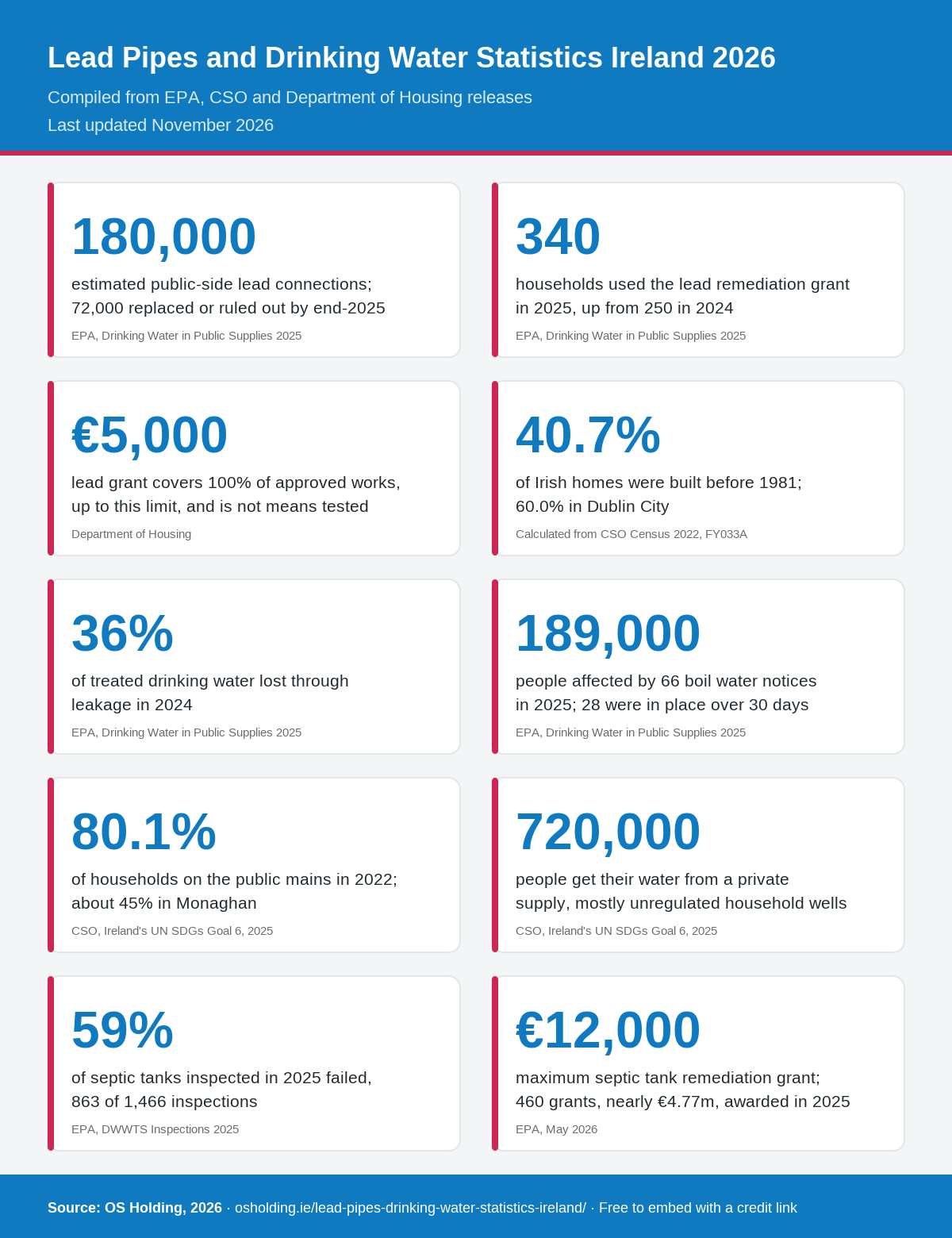
- Uisce Éireann estimated that there were 180,000 public-side lead connections; 72,000 had been replaced or ruled out as not containing lead by the end of 2025. Source: EPA, Drinking Water Quality in Public Supplies 2025
- That leaves an estimated 108,000 public-side lead connections, 60% of the original estimate, still to be found and replaced (calculated). Source: EPA, Public Supplies 2025
- 340 households used the Lead Remediation Grant to remove lead pipes in 2025, up from 250 in 2024. Source: EPA, Public Supplies 2025
- The Domestic Lead Remediation Grant pays 100% of the approved cost of replacing lead pipes, up to €5,000, and is not means tested. Source: Department of Housing, Local Government and Heritage
- 747,772 homes, 40.7% of all households, were built before 1981; in Dublin City the share is 60.0% (calculated). Source: CSO, Census 2022, table FY033A
- Ireland lost 36% of its treated drinking water through leakage in 2024. Source: EPA, Public Supplies 2025
- 99.8% of public supply samples met the microbiological standards and 99.7% met the chemical standards in 2025. Source: EPA, July 2026
- 66 boil water notices affected about 189,000 people in 2025, and 28 of them were in place for more than 30 days. Source: EPA, July 2026
- About 720,000 people get their water from a private supply, mostly household wells, which are not regulated. Source: CSO, Ireland’s UN SDGs, Goal 6
- 59% of the 1,466 septic tanks inspected in 2025 failed, 863 systems. Source: EPA, May 2026
How Many Irish Homes Still Have Lead Pipes
Nobody has an exact count of the homes with lead plumbing inside. The figure that exists is for the public side of the connection, the pipe between the water main and the property boundary. Uisce Éireann’s Lead in Drinking Water Mitigation Plan of 2017 estimated 180,000 public-side lead connections and planned to remove them by 2026. By the end of 2025, 72,000 had been replaced or ruled out as not containing lead, according to the EPA’s Drinking Water Quality in Public Supplies 2025 report, published on 1 July 2026. That is 40% of the estimate, leaving about 108,000 (calculated). Uisce Éireann is still sampling and mapping the network to locate the rest.
The pipes inside the property boundary are the owner’s responsibility, and they are not counted at all. The EPA notes that lead was used in pipework and plumbing up to and including the 1970s, and the Department of Housing says that homes built before the 1980s may contain lead pipes. A house that has had its public connection replaced can still have lead running from the boundary to the kitchen tap.
The Homes Most at Risk: Built Before 1981
The 2022 Census gives a sense of how many homes were built while lead was still in use. Of the 1,836,728 households in permanent housing, 747,772 lived in homes built before 1981, 40.7% of the total, according to CSO table FY033A (calculated). Not every one of these homes has lead pipes, since many have been replumbed, but they are the homes where it is worth checking.
| Area | Households | Built before 1981 | Share |
|---|---|---|---|
| Ireland | 1,836,728 | 747,772 | 40.7% |
| Dublin (four councils) | 518,490 | 248,499 | 47.9% |
| Dublin City | 225,519 | 135,279 | 60.0% |
Source: CSO, Census of Population 2022, table FY033A. Shares calculated by OS Holding from all households, including those where the year built was not stated.
Dublin City has the oldest housing in the country, with six in ten households in homes built before 1981. Our period and older homes statistics break the stock down by decade.
Lead Grants and How Many People Use Them
The Domestic Lead Remediation Grant Scheme funds 100% of the approved cost of replacing lead pipes inside the property boundary, up to €5,000. It is run by local authorities and is not means tested, according to the Department of Housing. Once the private pipework is replaced, Uisce Éireann’s Customer Opt-In scheme replaces the public-side lead connection free of charge.
Few households use the grant. Local authorities recorded 340 households availing of it in 2025, up from 250 in 2024, according to the EPA, and take-up of the Opt-In scheme almost doubled in 2025. Against an estimated 108,000 public-side lead connections still in the ground, that is a slow pace, and the EPA has asked local authorities to promote the grant.
| Lead measure | 2024 | 2025 |
|---|---|---|
| Households using the Lead Remediation Grant | 250 | 340 |
| Public supplies with ortho-phosphate treatment | 12 | 17 |
| Public-side lead connections replaced or ruled out (cumulative) | n/a | 72,000 of 180,000 |
Source: EPA, Drinking Water Quality in Public Supplies 2025.
The Legal Limit for Lead Will Halve in 2036
The legal limit for lead in drinking water falls from 10 micrograms per litre to 5 in January 2036 under the Drinking Water Regulations, and the EPA says that sustained compliance with the lower limit cannot be guaranteed without replacing all lead connections. As a stopgap, Uisce Éireann doses water with ortho-phosphate, which forms a protective coating inside lead pipes. It did so at 17 supplies serving more than 208,500 properties at the end of 2025, up from 12 supplies in 2024 and more than double the coverage of a year earlier, according to the EPA. The Departments of Housing and Health are due to publish a progress report on the National Lead Strategy in 2026.
Drinking Water Quality in Public Supplies
Public water is safe to drink for more than four million people. In 2025, 99.8% of regulatory samples met the microbiological standards and 99.7% met the chemical standards, according to the EPA’s release of 1 July 2026. E. coli was detected in 10 supplies through regulatory monitoring, and 24 supplies failed the limit for trihalomethanes, by-products that form when chlorine reacts with organic matter.
The EPA’s list of supplies at risk, the Remedial Action List, fell from 45 supplies at the end of 2024 to 35 at the end of 2025, and those 35 supplies serve 467,000 people.
Boil Water Notices and Water Restrictions
When a supply cannot be made safe, Uisce Éireann issues a boil water notice or a water restriction notice in consultation with the HSE. In 2025, 100 supplies were affected, against 84 in 2024, reaching almost 200,000 people, according to the EPA.
| Year | Boil water notices | In place over 30 days | Water restriction notices |
|---|---|---|---|
| 2024 | 59 | 33 | 25 |
| 2025 | 66 | 28 | 34 |
Source: EPA, Drinking Water Quality in Public Supplies 2025, tables 4.1 and 4.2. The 66 boil water notices of 2025 affected about 189,000 people and the 34 restriction notices about 2,000. Twelve of the restrictions were caused by manganese or iron, which can come from source water or from iron pipes in the network.
How Much Water Leaks Away
Uisce Éireann’s leakage assessment, completed in 2024, put the national leakage level at 36% of treated water. For the 25 largest public supplies the rate was 33.7%, with potential to reduce it to 26.8% by 2034, according to the EPA. The assessment was submitted to the European Union in December 2025, and the EU will set a leakage threshold for Ireland through legislation planned for 2028.
Where Irish Homes Get Their Water
In the 2022 Census, 80.1% of households were connected to the public mains, up from 77% in 2016. Group water schemes, public and private, supplied 7.7%, and other private sources, mainly household wells, 9.9%, according to the CSO’s report on UN Sustainable Development Goal 6. The Dublin local authorities and Galway City had about 94% to 97% of households on the mains, while Monaghan had just over 45%, the lowest in the country. About 720,000 people get their water from a private supply, and because private wells are not regulated, there is no information on their water quality.
For sewerage, 68.2% of households were connected to the public system in 2022 and 25.4% used an individual septic tank, according to the same CSO report.
Private Group Schemes and Small Private Supplies
About 376 private group schemes supply more than 194,000 people in rural communities, and more than 1,600 small private supplies, such as wells serving schools, crèches, nursing homes and hotels, are registered with local authorities, according to the EPA’s release of 29 July 2026. The total number of small supplies is unknown because registration is not required by law.
- 14 private group schemes, supplying 1,854 people, had E. coli failures in 2025, down from 24 in 2024; six of them failed in both years.
- 17 private group schemes, serving 19,362 people, failed the trihalomethane standard in 2025, against 19 in 2024.
- 67 small private supplies failed the E. coli standard in 2025, a compliance rate of 95%.
Septic Tank Inspections
Local authorities inspected 1,466 septic tanks in 2025, targeting the areas of greatest risk, and 863 of them, 59%, failed because they were not built or maintained properly, according to the EPA’s release of 19 May 2026. Faulty systems can contaminate drinking water wells and pollute rivers.
- 7,212 septic tanks have failed inspection since the programme began in 2013, and 84% had been fixed by the end of 2025.
- Failed systems with advisory notices unresolved for more than two years fell from 523 in 2024 to 442 in 2025.
- The septic tank remediation grant rose from €5,000 to €12,000 in 2024. 460 grants, worth nearly €4.77 million, were awarded in 2025, up from 265 in 2024.
What the Figures Mean for Homeowners
If your home was built before 1981 and the original plumbing has never been replaced, check the pipe where the supply enters the house, usually under the kitchen sink. Unpainted lead pipe is dull grey, soft, and shows shiny silver metal when scraped with a coin, as the Department of Housing explains. A renovation is the cheapest time to replace it, since floors and walls are already open, and the €5,000 grant covers the approved cost in full. Our guide to renovating an old house in Ireland covers the other works older homes usually need.
Method and Sources
Every figure was taken from the named source on 25 November 2026: the EPA report Drinking Water Quality in Public Supplies 2025 and its release of 1 July 2026; the EPA release on Drinking Water Quality in Private Group Schemes and Small Private Supplies 2025 of 29 July 2026; the EPA release on Domestic Waste Water Treatment System Inspections 2025 of 19 May 2026; the CSO release Ireland’s UN SDGs, Goal 6 Clean Water and Sanitation 2024, published 27 June 2025 and drawing on Census 2022; CSO Census 2022 table FY033A, private households by period in which built; and the Department of Housing, Local Government and Heritage release on the Domestic Lead Remediation Grant, last updated 12 April 2025. Figures marked calculated were derived by OS Holding from these sources: the remaining lead connections and their share, and the number and share of homes built before 1981. The page will be refreshed when the EPA publishes its 2026 drinking water and septic tank reports in mid 2027 and when the National Lead Strategy progress report is published.
How OS Holding Helps
OS Holding is a Dublin building contractor whose plumbing team replaces ageing pipework during house renovations and as stand-alone jobs, and every job is priced in a written, itemised quote before work starts. For a quote, request a quote or contact the team. Journalists and researchers are welcome to quote any figure here with a link to the source and to this page.
